Handmade Wood Headjoints in Grenadilla
(And Other Exotic Hardwoods)
I have always enjoyed playing wood flutes. After years of contemplation and many wood flute experiments, opportunities came about to realize my ideas. The current headjoint design is a reflection of my personal experience and is influenced by many of my good friends who are wonderful flute players and fellow flute makers.
My two favorite flute makers, Louis Lot and Rudall Carte, made wooden flutes using only grenadilla (African blackwood) and cocuswood. Renaissance and Baroque woodwind instrument makers had a larger selection of wood, ranging from European boxwood, ebony, cocus, rosewood and softer woods such as pear and maple. I make my headjoints in grenadilla, cocobolo, cocuswood, European boxwood, mopani, pink ivory, mountain mahogany, bocote, tulipwood, olivewood, and many others. I enjoy the visual beauty and workability of these woods, however, it is the acoustic and ergonomic design that gives the voice to the headjoint. Every headjoint is handmade and unique. The subtleties in each variety of wood present an addition level of individuality within each headjoint.

Grenadilla (Dalbergia melanoxylon), or African blackwood, is a classic wood of choice for making Boehm flutes. It is a very dense wood and easy to turn, carve, file and cut. Its grain structure is very tight and a smooth finish can be achieved quickly by sanding. The bore is sealed, but there is no finish on the outside of grenadilla headjoints. The oil from the player’s hands would eventually be absorbed into the wood and gives it a fine sheen. The color of grenadilla ranges from black to a dark chocolate brown. The sound is strong with rich resonance and warmth, does not thin out in the high register, and generally has a deep quality.
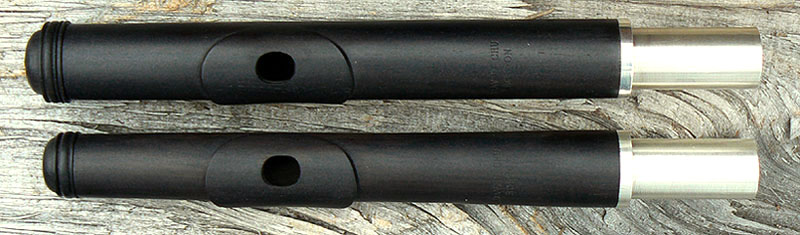
The two headjoints above are both made of grenadilla, the one on top is the regular thinned model and the bottom is extra thinned with an average wall thickness of about 1/16 inch. The lipplate is not applied but carefully hand carved from the same piece of wood. The extra-thinned headjoint produces a sound that is brilliant and clear, and gives the player the familiar feeling of playing on a silver headjoint but with an added dimension that is not available to a modern silver head.

Cocobolo (Dalbergia retusa) is a dense wood from Central America. It is orange brown in color with distinctive black straight or wavy lines throughout. The color darkens in time. It is a very beautiful wood and takes a mirror finish. However, I choose a warmer satin finish for my cocobolo headjoint. This wood is stable in a high moisture environment. I find more brilliance in the cocobolo than grenadilla. It is freer blowing as well due to the slightly lighter wood.
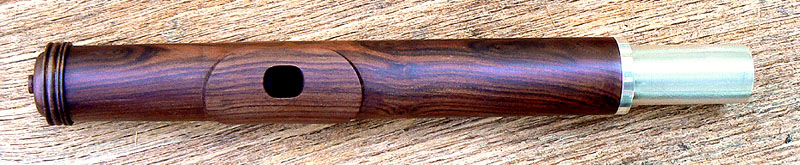
Cocuswood (Brya ebenus) is a very dense tropical hardwood. It comes from the West Indies and supplies are very limited. Long pieces that are suitable for making a whole flute are almost impossible to find. The color is a brownish black and turns very dark after repeated handling. Louis Lot and Rudall Carte made many wood flutes in cocuswood that are highly sought after by players and collectors today. Cocuswood is very hard but lighter than grenadilla; this unparalleled balance gives the headjoint power, warmth, speed, smoothness and a variety of tone colors.

European boxwood (Buxus sempervirens) has been used in flute making for several hundreds of years. It’s not as dense and hard as grenadilla and has a very fine grain structure. This lighter wood allows a mellower voice with surprising projection, very distinct. The natural color is pale yellow; many pieces have dark lines. Traditionally, acid staining is used to turn the wood into a more uniform orange brown to dark brown color. I prefer a natural finish without stain.

For Baroque flute players, I designed a no lipplate boxwood headjoint with a little oval embouchure and a traverso styled crown. This headjoint gives the player a familiar feeling when switching between early flute and Boehm flute. Baroque flute techniques and expressions can be transferred freely to the modern flute with satisfaction. Some players favor this design for its quickness in articulation when playing rapid large intervals.
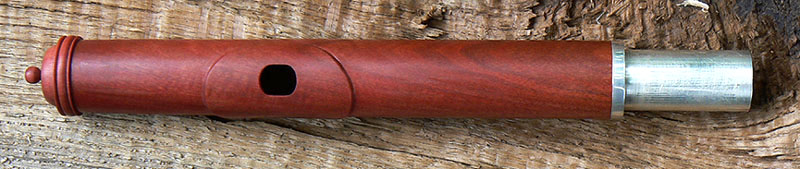
Pink Ivory (Berchemia zeyheri) is a very rare wood from southern Africa. It is a very hard and dense wood. The color ranges from light to dark pink and will darken in time. It will take a high polish, but again, I prefer to give it a satin finish. The look of my pink ivory headjoint on a silver flute is striking. It’s focused sound can penetrate as well as blending with ease when playing with other instruments.

Brazilian Kingwood (dalbergia cearencis) is a very beautiful brown color wood with a violet hue and fine dark stripes and swirls. It belongs to the rosewood family. It is not as dense as grenadilla and produces a lighter, brilliant sound.

Mopani (Colophospermum mopane) is a very hard and heavy wood that grows in Africa. The color is reddish-brown, interspersed with thin, dark veins; darkens with age. It works relatively easy and takes a good finish. This headjoint produces a loud and impressive tone.

Tulipwood (Dalbergia frutescens), from Brazil, has distinct stripes of rose and salmon over a light yellowish background. It produces a perfume fragrance when freshly cut. The sound is mellow and centered, an alternative to boxwood. A beautiful wood for headjoint making.

Mountain Mahogany (Cercocarpus) comes from the western parts of the United States. There are few native woods from the United States that meet the density and various requirements for making headjoints. Suitable pieces of aged mountain mahogany for flutemaking are treasured for special occasions. The color of the wood is a warm deep brown and very attractive; it looks very similar to the common mahogany but the two are not related. The tone is very flexible and colorful.

Bocote (Cordia elaeagnoides), from Central America, is a spectacular wood with many contrasting dark and light, straight or swirl, narrowly spaced lines throughout. It produces a bright and powerful tone. The density is slightly greater than boxwood. It is a very resonant wood.

Western Myall (Acacia papyrocarpa), from Australia, is one of the few rare woods that is as dense and heavy as grenadilla and mopane. I have not seen this wood used for woodwind instrument making. The deep brown color marked with black flecks is very beautiful and its oily nature makes it quite resistant to moisture. The sound is very deep but with brilliance when required.
My wood headjoint design is simple: Make a taper that would work well with an embouchure hole and a comfortable lipplate to direct the air into the right place. It is the geometry of the bore and the embouchure hole that determines the characteristics of a headjoint. The type of wood and its essence also influence the identity of a headjoint in a subtle way. The desired sound is achieved by hand cutting the embouchure hole. The voice of the headjoint slowly emerges as the wood is carefully cut away a little at a time. Priority is given to response and character of sound.
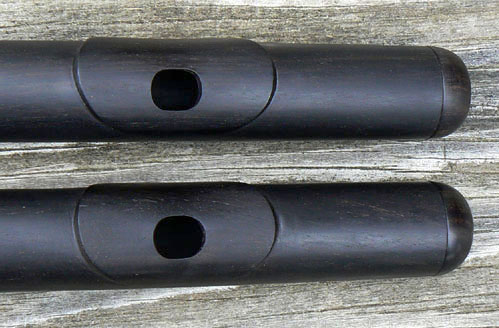
There are two main styles of embouchure holes that I make: square (top) and slightly oval (bottom). Square embouchure gives a brighter sound and is easier to control for some players. Oval embouchure sounds more mellow and woody and stimulates an intimate feeling. The preference is personal. I often choose the oval for playing Bach and Handel. I also integrate Louis Lot’s embouchure designed for their silver flutes with my wood headjoints. The above headjoints are fitted with plain crowns.
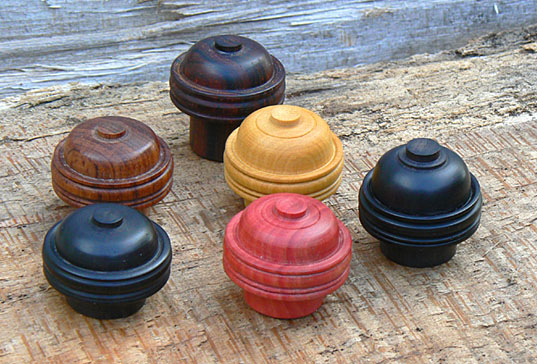
Above are ornamental crowns. The wood used are, clockwise from far right to left: grenadilla, pink ivory, grenadilla, mopani, cocobolo, boxwood. Ivory alternatives are also available.
The tenon is made of silver and can be fitted to a 0.014 or 0.016 barreljoint of a silver flute. It is secured to the headjoint with shellac. I take pleasure in making the crown and offer many decorative styles. The actual weight of my wood headjoint is about the same as a silver headjoint. For people who would like to use my headjoint on a wooden flute, I offer to custom make an adaptor to accommodate the union.
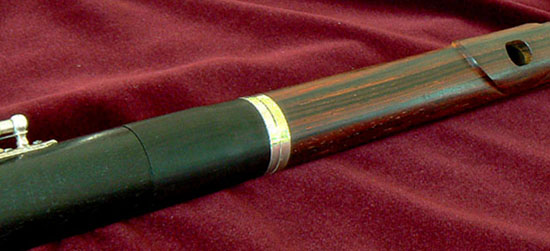
Pictured above is one of my cocobolo headjoints fitted to a wood Louis Lot using an adaptor I made from grenadilla.
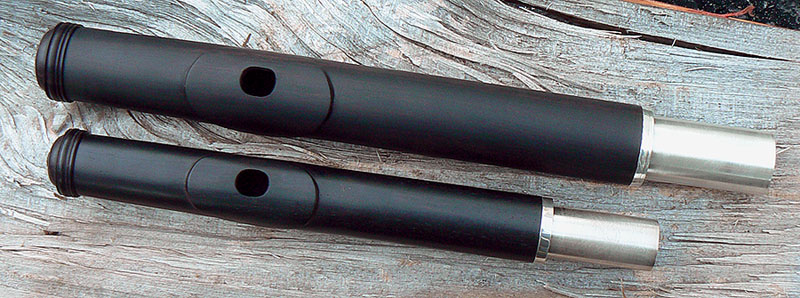
This wood alto headjoint is big. It makes my alto flute roar. A good piece of music to play is Schubert's Arpeggione Sonata. Email inquiries about sheet music availability. I also make wood headjoints for bass flutes, flute d’amore, Eb flute and piccolo.

This is a grenadilla headjoint without a lipplate. It is slightly heavier than the thinned headjoint with lipplate and sounds a bit deeper and more woody. The challenge for such a design is getting the proper relationship between the wall height and the outside curvature. A large diameter will result in a higher wall but it may be uncomfortable for the player due to the curvature touching the chin. A reduced circumference would create a steeper front wall for freer blowing but would definitely diminish the front wall area, producing a smaller target for the airstream. Without using a lipplate design, there are many ways one can control these parameters, some are more elegant than others. One of the ways is to use an eccentric bore:
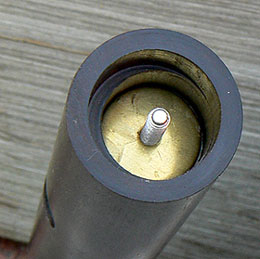
The inside bore is not concentric to the outside diameter. The maximum eccentricity is at the top of the headjoint while the bottom, where the tenon fits into the flute barrel, is concentric. A no lipplate headjoint preserves the look of a baroque flute, an old Haynes or a Louis Lot wooden flute. Irish flute maker, Terry McGee, has a good story on the shape of the head.
Here are a few words from flute players about my headjoints.
Please check here for a price list.
To care for your wood headjoint, see the Maintenance Guild.
For more information please e-mail david at sideblown dot com




